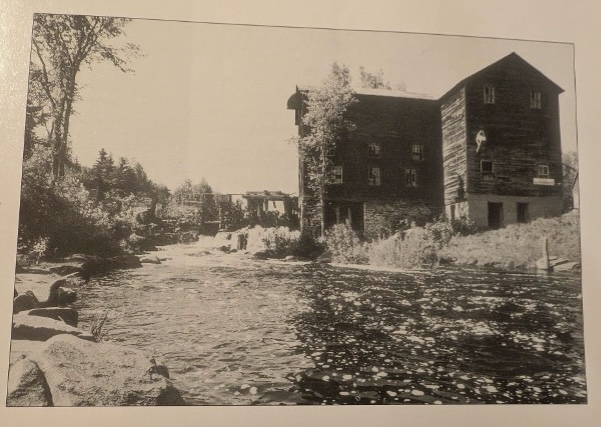
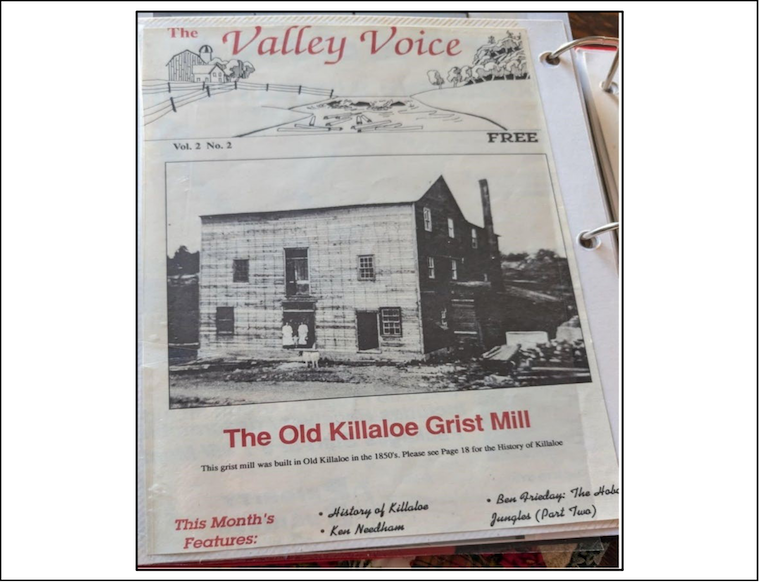
There is a lot of confusion in researching the history of the Mill on the pond on Brennan’s Creek because sometimes the building and dating of the Flour/Grist mill is confused with the building and dating of the sawmills that were built along the creek – sawmills of which there is no longer any visible trace. Above: An old picture of the Mill found in the Killaloe Pioneer Museum when it was being cleared for demolition in 2020. (Photo: Killaloe Heritage and Ecology Society)
There has long been discussion about when the flour and grist Mill was built in Old Killaloe. Local hearsay says that it was built by Joshua Hazelton in 1849, burned at some later date, and was rebuilt in the late 1870s. The records, however, point more strongly to the original Mill, before add-ons, being built on Brennan’s Creek circa 1877.
There are two sources that would confirm this:
The first is an 1881 letter from Mr. John Riche [Roche?] of Brudenell to the Pembroke Observer, published under the title “Killaloe: A Town That Will Grow” and later printed in Carol Bennett’s book The Valley Irish (Juniper Books 1983):
1. “Have you ever been at Killaloe?”
“A backwoods hamlet not, but a stirring town by the all-hails hereafter. As it is of very recent origin it is not probable that you will find it on many of the maps of present day, so I will endeavour to describe it. To begin with then, it lies some twenty miles west of Eganville, and is situated on Brennan’s Creek, about two miles above where that stream enters Golden Lake.”
“Mr Joshua Hazelton [aka Joziah] was the pioneer of the place; to his enterprise and energy is due the first origin of the village. Here it was that some 6 years ago ‘in the bosom of the forest’ he first conceived the idea of erecting a grist mill, a want long felt by the settlers of the surrounding country… in less than 18 months he had erected and completed a grist mill which, in its machinery and general equipment, is second to scarcely anything of its kind in the County. It is furnished with two runs of French-Burr stones — each run being capable of grinding from 12 to 20 bushels an hour.”
“As to the grade of flour turned out by the mill, it will be sufficient to say that it stands in a section of the country well adapted for wheat growing, and that the work is performed by Mr. Beach, who is considered one of the first millers in the Province.”
“As might have been expected Mr. Hazelton’s enterprise has proved to be the foundation of a village.”
“Soon after the completion of the mill there sprang up a couple of blacksmith shops and a hotel, and some twelve months ago Mr. John Knight, who also keeps the Post Office, established a general store, where the requirements of the surrounding settlers are supplied as reasonably as in most of the large towns.”
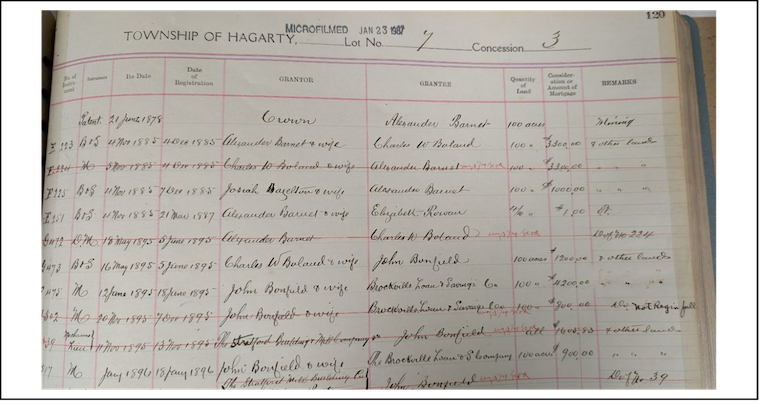
On the 1881 census of Hagarty, Joziah Hazelton is shown as a carpenter, aged 35. This means he was born about 1845, which would have made him about four years old in 1849. He therefore could not have built the Mill in 1849. As a carpenter living in Killaloe in 1881, he may well have been the builder and driving force behind the Mill in the 1870s, as the letter suggests. He would almost certainly have needed a financial patron, so it may not be a coincidence that in 1878 Alexander Barnet, a Renfrew businessman and entrepreneur, patented the lot on which the Mill was built.
2. The second important reference is from the agent’s report on Hagarty Township below, taken from The Undeveloped Lands in Northern and Western Ontario, by A. Kirkwood and J. J. Murphy, published by Hunter, Rose and Co. in Toronto in 1878:
“There are two sawmills on Brennan’s Creek and a grist mill is now being built. Upon this creek there are a great number of water powers, and water-powers might also be got on Byer’s Creek; and on the Bonnechere, a short distance below Round Lake, there is another excellent water-power. There are as yet no villages in the township, the settlers’ business being transacted either at Eganville or Brudenell Corners. The township has this year been organized into a municipality; there is one church* (Roman Catholic) in the township, and two schools.”
“Improved farms can be purchased at from $3 to $8 per acre.”
The same report also noted the timber works on the Bonnechere:
“Strong and well-built timber dams and slides have been erected on these rapids, I think as many as seven, at an outlay, I was informed, of $10,000. Of the four lower dams which lie within a space of half a mile, the two middle ones are in close proximity to the location of William MacDonell. About 10 chains below Mr. MacDonell’s clearing the stream becomes navigable, and after winding its way through a low wet flat, covered with soft maple, ash and alder bushes, it discharges itself into the southwestern extremity of Golden Lake.”
It seems more likely that “the mill built in 1849 by Joshua Hazelton” was an earlier sawmill on Brennan’s Creek, possibly at or near the same waterpower as the Mill that stands today. If a “mill” burned down, it may also have been a sawmill rather than the later flour and grist Mill.
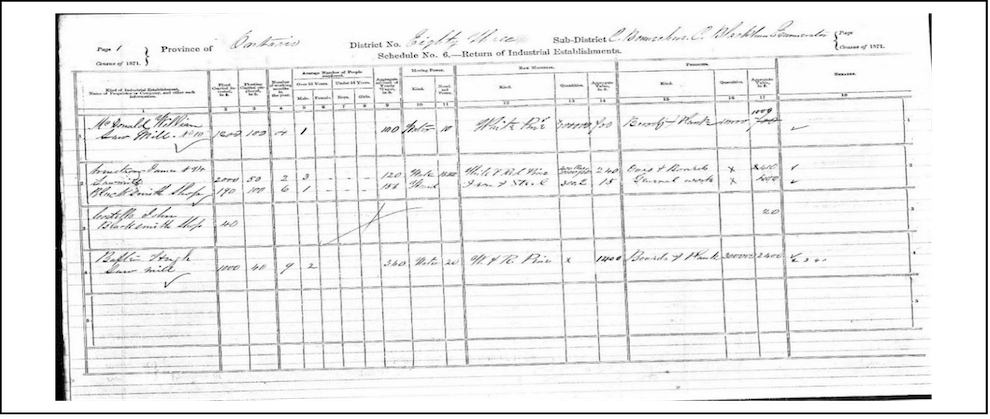
On the 1862 overview map, four dams and slides are shown on Brennan’s Creek. One appears at the site of the present Mill, and another appears on the creek property owned by William MacDonell.
A tangled history
This is where the history becomes tangled. When later writers discuss the history of “Killaloe,” it is often difficult to know which mill, which sawmill, which MacDonell, and even which Killaloe they are referring to. For example, it has been said that the original (old) Killaloe Mill burned down and that a new Mill was built about 1875. It has also been said that William MacDonell’s sawmill in Killaloe burned down in 1898. That second is confusing as MacDonell’s sawmill was located in Fort MacDonell in 1898, which is now Killaloe.
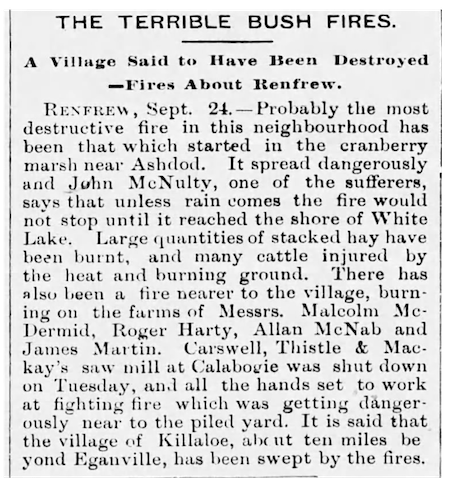
Fire was a common threat to sawmills because sawdust is extremely flammable, so it is quite possible that an earlier mill at that dam where the Mill stands today, was a sawmill and that it may have burned down. Besides the vulnerability of sawmills to fire, there were also bushfires, as there are today. The newspaper report above from The Kingston Whig-Standard, Nov.26 1877, says that “the village of Killaloe, about ten miles beyond Eganville, has been swept by the fires,” but I have not yet found more concrete evidence that a fire swept through Old Killaloe in late 1877.
As noted above, it has been said that the Mill burned down and that a new Mill was built about 1875. However, I have spoken with two recent owners of the Mill who cleaned the dam back to bedrock, and both told me they found no sign of fire damage in either the mill building nor in the dam.
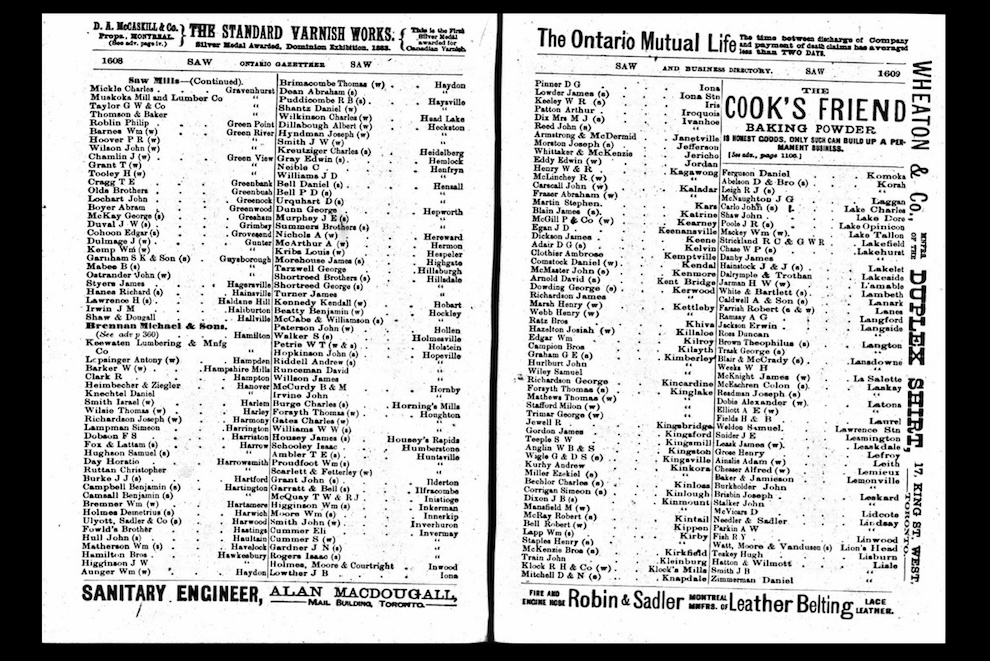
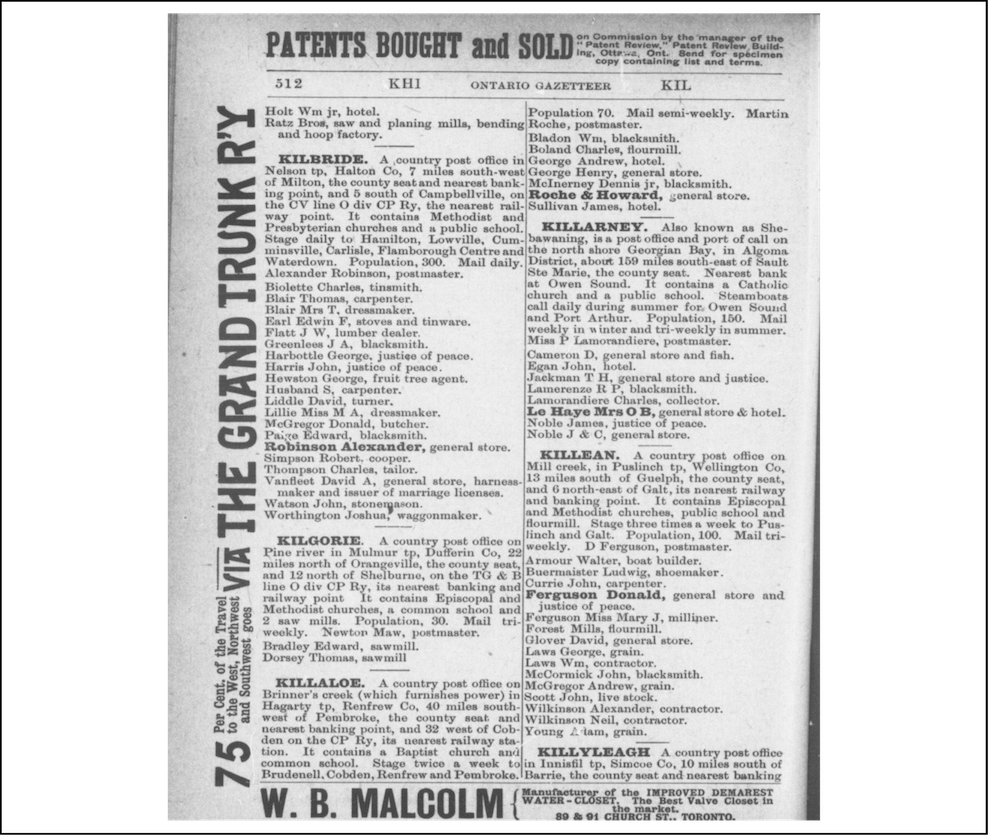
In 1876, Joziah Hazelton is recorded on his son Cornelius’s birth certificate as a carpenter living in Killaloe. On the 1881 census he is listed as a miller, while Charles Boland is named as mill owner. This is confirmed by the 1888/89 Ontario Gazetteer and Business Directory listings. Most of the Killaloe entry in the 1888/89 Ontario Business Directory and Gazetteer was the same as in the previous 1884/85 directory. The notable changes were that the population had risen by 20 families, “Hazelton — sawmill” had been dropped, and “Boland — flourmill” had been added.
In August 1891, the Kingston Whig-Standard reported that William MacDonell planned to put a steam engine in his sawmill in Fort MacDonell.
On the 1891 census of Hagarty Township, Boland is shown as the owner of the Mill in (old) Killaloe. A note in the Kingston Whig-Standard dated September 7, 1891, reported that Boland planned to put rollers in the mill. (See extract below)

In 1892, before he did this, Boland began the process that led to the sale of the Mill to John Bonfield, son of James Bonfield.

The Weekly British Whig reported that Killaloe village offered a bonus to anyone who would build a rolling mill there. (See extract above) John Bonfield bought the Mill in 1895 and said he would build a roller mill.

A later newspaper item (See above) confirmed that Bonfield planned to put rollers in the Mill. The Killaloe land registry records show that Boland sold the Mill to Bonfield in 1895, and a newspaper report confirms the sale.
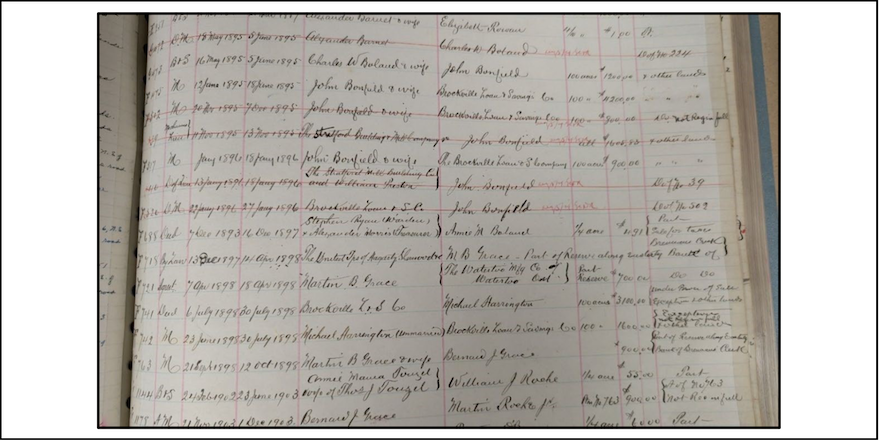
Unfortunately, things did not go well for Bonfield. In 1902, it is recorded that he owed back taxes for the Mill. Had he exceeded the ten-year tax exemption he had been offered? In his memoirs, Green tells us that Michael Harrington purchased the Mill in 1906, although the 1901 census of Hagarty Township shows Harrington as a mill owner and operator, and “Buston?” as a miller.
In 1906, Harrington hired Sydney Bay, a qualified miller from the United Kingdom, to run the Mill.
On the 1911 census Bay is described as a grist miller. In 1919 he was joined by his brother-in-law, Edward Wood, who had been a baker before serving as a corporal in the First World War. Sydney Bay and Edward Wood bought the Mill from Harrington about 1919. By this time, however, local farmers had gradually stopped growing wheat, and the demand for grinding flour had waned.
The 1919 photograph below shows that the Mill had been extended with the addition of a two-storey building and another floor on the original building. I haven’t found documents that say when the addition was built, but surmise that it was built by Bonfield to house the rollers that he was going to add.
On the 1921 and 1931 censuses, Bay and Wood are both described as millers and mill owners. According to Ancestry records, Wood died in 1946. Bay switched to grinding grist for animals, but eventually he converted the Mill into a wood-planing mill and kept it going until his death in 1968. In 1966, two years before his death, Mr. Bay gave this interview with the Globe and Mail about the Mill.
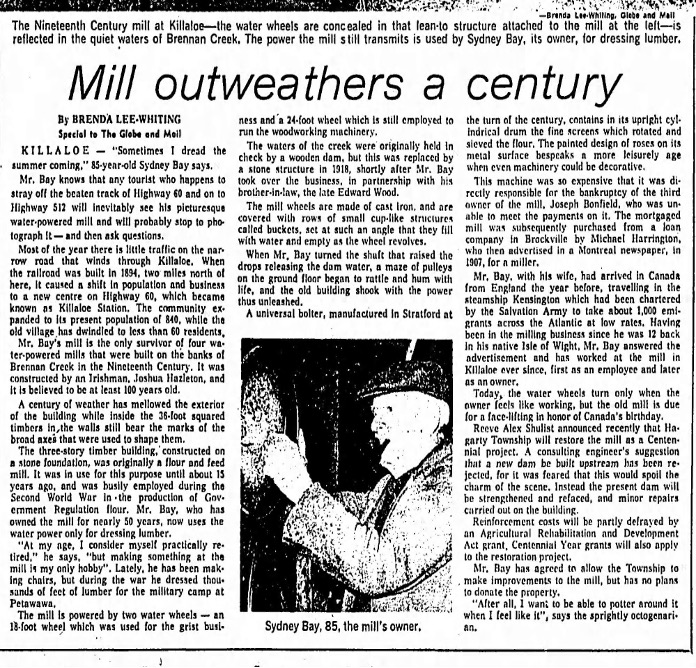
In 1969, Ben Johnston bought the Mill, which by that time was no longer a working Mill. At its peak the Mill had been powered by one wood-powered engine and one water-powered engine, and it operated 24 hours a day during the season, grinding the wheat harvested for local farmers. With the rise of national commercial mills, local grain milling became a thing of the past, as it was no longer profitable to grind grain or grist for livestock feed.
Ben Johnston’s son, Joe Johnston, gave me the following notes about his father’s ownership:
“In the 1970s Ben Johnston worked at renovating the Mill, and much of that time was spent reinforcing and strengthening the adjoining dam. In the 1970s, the dam was crumbling but not broken. There was no railing or steel on top, and it was only half the width it is now. Nevertheless, that fine old gentleman, Syd Bay, had been managing the drop logs for 30 years. Johnston emptied the Mill Pond and spent over two years removing the drop logs, then used steel and concrete to entrench the dam into the bedrock.”
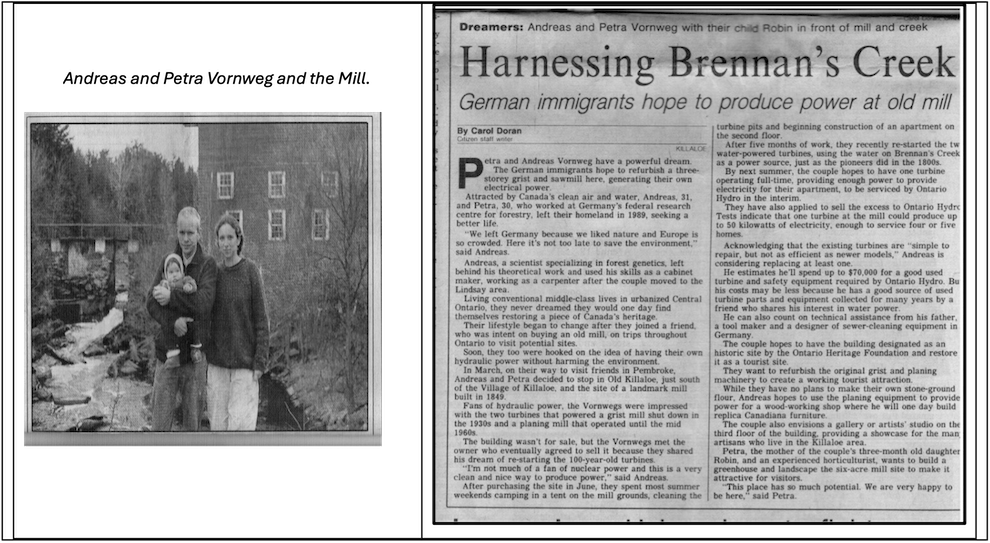
Ben Johnston put the Mill up for sale about 1988. In 1990, Andreas and Petra Vornweg bought the Mill. Over the 20 years that he and his family lived there, Andreas continued to renovate the Mill, making many improvements to the Mill and added living quarters. They later sold the Mill, but the new owner had a change of heart, and it was sold again to the present owner. I do not have the dates of these later sales.
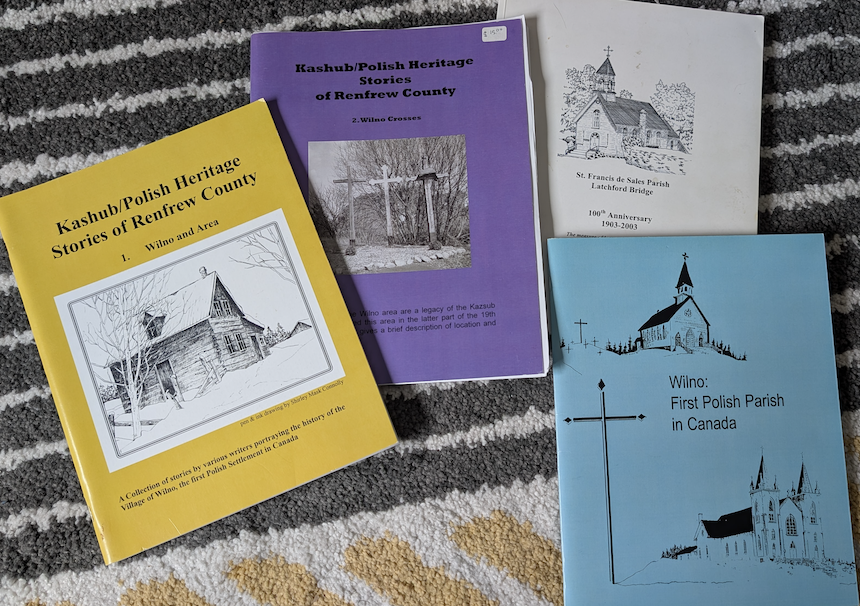
About the author: Lynne Postill, originally from Leeds, Yorkshire, emigrated to Canada in 1966. Whilst living in Poland in 1995-98, she wrote articles on the Holocaust. In Indonesia, she wrote several books on English conversations for Indonesians. Over the last 25 years, Lynne Postill has written books and articles on local history. (See covers below) This article about the Mill at Old Killaloe is one chapter from her forthcoming History of Old Killaloe.