
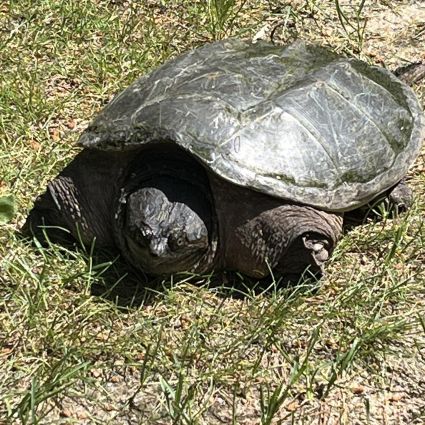
Editor’s note: Carson Trout Lepine and Greenan Lakes Association submitted this article for publication in The Current. It was written by Kelly Wallace of Think Turtle for the CTLG membership. Wallace explains below how you can help turtles, especially during September – the “busiest” time for turtle hatchlings trying to reach water. Above: snapping turtle seen at Trout Lake, June 2025. (Photo: CTLG)
Turtles have been roaming the Earth for over 200 million years. That’s longer than the dinosaurs, and definitely longer than the internet. These ancient, slow-moving creatures play a crucial role in keeping ecosystems healthy. They help balance food webs, clean up waterways, control insect populations, recycle nutrients, and even plant new vegetation as they go about their daily lives. In their quiet way, turtles are nature’s unsung caretakers.
But in Ontario, their future is hanging by a thread. All eight native species are now listed as at-risk, some of them critically. Roads, habitat loss, poaching, and predation are wiping them out faster than they can recover. Female turtles are slow to reproduce, with species such as Blandings and snapping turtles taking 17 to 20 years to reach sexual maturity. Many do not survive to this age, and if they do, it can take years before laying their first viable clutch of eggs due to predation, weather events, or human disturbances. Even then, fewer than one in a hundred hatchlings will survive to adulthood. This is a long game, and right now, turtles are losing.
The ones who care (that’s you)
Thankfully, more and more people are stepping up. Neighbours, hikers, farmers, cottagers, and community groups are pitching in to give turtles a fighting chance. Across Ontario, grassroots volunteers are installing road signs, building nest protectors, helping turtles safely across roads, guiding hatchlings to water, and transporting injured turtles to Ontario’s turtle hospital. Groups like Think Turtle, Turtle Guardians, the Ontario Turtle Conservation Centre, and many local champions are proving that community action can make all the difference.
So, what can you do?
Be ready to get hissed at, peed on, or maybe even snapped at. If it means saving a turtle, it’s worth it. Every encounter with a human is stressful for a turtle, so if you can help without touching them, that’s always best. But when a turtle is on the road and in danger, you may have no choice but to intervene. They won’t understand your intentions, but if it’s a matter of life and death, they’ll have to trust you.
As early as the first week of May, turtles start moving. Some are overwintering hatchlings emerging for the first time. Others are adults heading out to mate, forage, find nesting sites, or escape habitat disturbances and shifting water levels. This activity continues into July, and turtle movement can last well into October.
Be road ready
If you’re driving on highways, cottage roads, backroads, or trails from spring to fall, expect to see turtles. Being prepared makes it easier to help safely. Keep a safety vest, gloves, and hand sanitizer in your vehicle. If you’re not comfortable handling a turtle, a snow shovel works well to scoop and guide it across the road gently. For injured turtles, keep a flattened cardboard box or two in your trunk, some duct tape, a tool to punch air holes, and a notebook to jot down where the turtle was found.
How to help a turtle cross the road
Safety always comes first. Pull entirely off the road and turn on your hazard lights. Think about your safety and the safety of your passengers and other drivers before stepping out.
If you do stop to help a turtle, always move it in the direction it was heading. Even if it doesn’t make sense to you, that turtle has a destination in mind. Redirecting it will only cause it to turn around and try again, putting it at risk all over again.
Nest protection and permissions
Turtle nests are under constant threat from predators, weather, and human activity. If a turtle lays eggs on your property, you can install a nest protector to improve the odds. Visit https://thinkturtIe.ca/make-a-nest-protector for instructions to make a nest protector or purchase a preconstructed one.
However, if the nest is on public land, a roadside, a trail, or someone else’s property, you must get permission before doing anything. Unauthorized nest protection can lead to liability issues, even with the best intentions.
Helping hatchlings get to water
Most hatchlings emerge from mid-August through October, with September being the busiest time. They need a shallow, slow-moving body of water with plenty of vegetation or leafy debris. This provides shelter and resting spots.
If you find a hatchling, look around. Where there’s one, there may be more. Painted turtles usually lay 7 to 13 eggs. Snapping turtles can lay over 50 eggs.
Assisting a hatchling from the nest area to its intended water source is allowed and often necessary. The path from nest to water is full of threats. Predators may include crows, raccoons, skunks, foxes, seagulls, hawks, owls, fishers, snakes, frogs, and even domestic pets.
Bring hatchlings to calm, shallow water, not a beach, boat launch, or open shoreline. Never place them in stormwater ponds or busy public areas. Set them at the edge of a safe entry point and let them walk in themselves. Spacing multiple hatchlings about ten feet apart reduces the chance of predators finding them all at once.
Handle hatchlings as little as possible. Their shells are soft and delicate. Wearing gloves is a good idea. And remember, turtles belong in the wild. It’s illegal to keep them as pets, especially species at risk.
Injured turtle? Don’t leave it behind
If you find an injured turtle, don’t assume it’s beyond help or that it is dead. Badly wounded turtles can often still be alive and/or be saved. And many injured females may still be carrying eggs.
Call the Ontario Turtle Conservation Centre (OTCC), home of Ontario’s Turtle Hospital, at 705-741-5000 when you are with the turtle. They offer free medical care and can arrange a volunteer “turtle taxi” to pick it up from you at a fixed address if you’re not able to drive. Every minute counts, so make the call as soon as possible.
Nest or hatchling concerns?
If you find exposed turtle eggs on the ground or in the water, or your dog digs up a nest or hatchlings, or you accidentally disturb overwintering hatchlings while winterizing your garden, doing property upgrades, or a nest is in a harmful location, contact the nearest turtle conservation group for guidance. Think Turtle Conservation Initiative can be reached at 647-606-9537 (text/call).
Do not move or attempt to incubate turtle eggs. They’re extremely sensitive, and a single shift can stop development. In Ontario, it is illegal to move turtle nests or possess turtle eggs without a permit from the Ministry of Natural Resources and Forestry. Fines can reach up to $25,000. Only authorized groups can collect eggs as part of scientific programs.
Small acts, big impact
You don’t need to be a biologist to make a difference. Mowing your lawn a little less, leaving natural areas along the shoreline, or talking to your neighbours about turtle safety all add up.
You can also join a turtle monitoring program, volunteer for a nest watch, donate to a rescue centre, or just be someone who pulls over to help. Change often starts with one person, one act, one turtle.
It starts with you.
If you have questions about a turtle, a nest, or anything in between, reach out to Think Turtle Conservation Initiative. Call or text us at 647-606-9537 seven days a week.
Thank you for caring and for being part of conservation efforts that help protect turtles and ensure future generations of turtles thrive.