

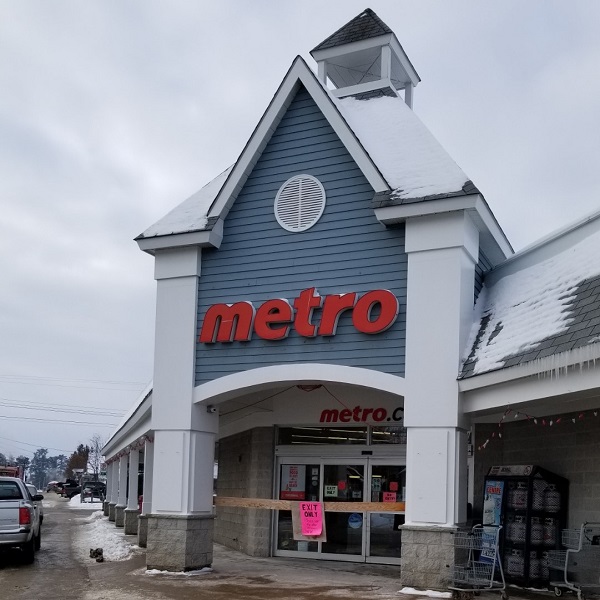
As COVID-19 continues to extend its lifespan and mutate, among its many consequences is the fear of acute disruption in the food supply chain. With this in mind, The Current reached out to Barry’s Bay Metro for feedback on the local experience and spoke with co-owners Gerard O’Malley (above left) and Neil O’Reilly (Shown with third owner, Connie O’Reilly, at Metro’s 25th anniversary celebrations in 2019).
No significant shortages
Both businessmen said they have seen no evidence of panic buying at this time, saying that there was a lot of choice for shoppers. O’Malley said, “Sporadically you’re going to have things missing but right at this time there do not seem to be a lot of issues.” Recalling the recent optimism expressed publicly by the heads of the major Canadian grocers about maintaining a strong supply chain, O’Reilly said, “They are pretty confident – as we are.”
O’Malley added that the only category of goods that had been affected were Asian products that arrived on overseas “containers and are not getting unloaded fast enough.” He specified dry goods; for example, Asian noodles, and O’Reilly chimed in with canned mushrooms, pointing out that “China is a big supplier of those.”
O’Reilly pointed out that where there are labour issues or covid outbreaks in a manufacturing facility, there will be isolated shortages of certain products. Citing as an example Cargill Beef in the early days of the pandemic, he said, “We’ve seen a few like that where a company has been hit harder than others…. There’s more of that happening now but it doesn’t affect a huge part of the business.” They explained, however, that stress is being felt all along the supply chain – whether it is the challenge of transporting goods across the ocean, unloading them at the ports, all the way to employment stresses felt in different industries and factories – including those closer to home.
He said that when a gap arises, Metro can provide customers with an alternative product from a different supplier, a private label line, or even suggest a different product.
We asked them if a Valley location put their store at a disadvantage when it comes to delivery schedules, but O’Malley said that, on the contrary, with their two to four hour delivery windows, it seems that Metro’s shipments are being prioritized slightly more than those for city supermarkets. He said, “We’re very pleased with our deliveries to the store and our fill rate.”
Price rises are inevitable
O’Reilly said, “You can’t escape from inflation – it’s a reality out there. Price increases in different sectors happen all the time…. We have become a society where we do want things and that’s what spins the economic wheel.”
O’Malley added, “The farmer pays more for his fuel, it takes him more to get it off the field, to ship it to the plant, to have it processed…. Fuel [is] really hurting every small business…. It doesn’t matter if you’re manufacturing or you’re in food [production] – it really adds to the cost of goods.”
“The costs are there and again we will definitely see the price of propane, the price of heat, higher this year,” said O’Reilly. “Whenever there’s a price increase at the bottom level it trickles up to the consumer; and people can’t fool themselves either — when wages go up in all sectors, [inevitably that] makes its way into the pricing…. The good thing with us is being a long time established business, we are not as susceptible to the highs and lows. We’ve got a balanced approach to this business, our priority being basically keeping and maintaining a good, dedicated staff and supporting the community as much as we can in whatever way we can.”
Gratitude for staff and customers
“As happy as we were to be busy all along,” said O’Malley, “It’s two years into it and it is wearing the staff down.” O’Reilly agreed, “We are amazingly grateful for their dedication and their ability to show up for work under all conditions. Also [for] a customer base that is basically “Home Town Proud” and they have supported us.” He said they feel for the small businesses that were forced to close, and they hope that they will be able to come back to be a part of commerce again, as that will benefit everyone.
O’Reilly said they have witnessed many instances “in our store where people are being kind to people, and respectful, and generous. The more we foster that and promote that, we are going to be in a better place. We are all going to learn from Covid but we’re going to be in a better place afterwards — either to be more prepared or more educated on the effects of something as major as a pandemic.”
He concluded by saying, “There is no bigger compliment that somebody [who] comes into the story and says, ‘Well you guys, it seems kinda seamless here; things are kinda running as smooth as anything.’ Yet Gerard and I have just juggled for ten people that [were] not able to make it into work. That’s credit to the staff that have been willing to cover for their coworkers and make it look like it’s business as usual.”
A great big thanks to all the staff that have been there for us throughout the pandemic. You are our heroes!
My store of choice! Great employees!
Kudos to Metro and the staff!! Shopping is easy and the staff is always pleasant and helpful.