
Opinion
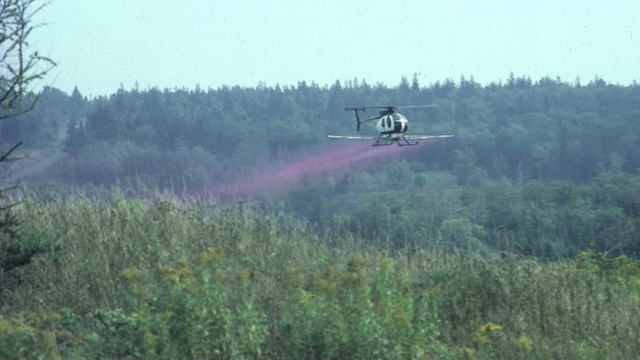
For the first time in three decades Ottawa Valley forestry practices are being publicly challenged over glyphosate spraying. The uprising is growing exponentially and rattling the forest industry. The spraying is intended to reduce intra-specific competition until planted seed stock reach a “free to grow” state after about 10 years. Simply put, it is the most cost-efficient method of site preparation and tending. It is also potentially the most harmful. Above: a helicopter releases a silvicultural application of the herbicide glyphosate to a clear-cut in Nova Scotia. (Source: B.Freedman, retrieved from https://ecampusontario.pressbooks.pub/environmentalscience/chapter/chapter-22-pesticides/)
Sustainable yield practices were replaced by economic expediency several decades ago. Local forestry giants have successfully gained the confidence of the population by providing employment and civic involvement. Hence, our community’s reticence over criticizing any of its questionable harvesting practices, such as clear cutting and herbicide spraying .
The advent of tree harvesters, cable skidders, grapple yarders and other massive logging equipment has not only led to a reduction in forestry jobs, but turned many of our forests into ecological wastelands. The $5.5 million government-subsidized upgrading of the Ben Hokum mill despite its many benefits has also led to a reduction in local employment.
Yet local politicians staunchly refuse to face the inevitable reality that the forestry sector is in crisis. Recreational tourism has taken a back seat in the cutovers which increasingly pass as scenic landscapes.
The digital age witnessed a decline in outdoor recreation in the late 1990s and hence public exposure to these atrocities which we call “forest management.” Industry has capitalized on this reduced interest and has been remarkably successful in its public relations campaigns convincing the public that harvesting is sustainable and even a necessity to forest growth.
Now a more sophisticated urban population is settling in rural areas with fewer ties to industry and a heightened sensitivity to the adverse environmental effects of industrial logging in their backyards.
Aerial spraying of glyphosate is only one of the serious impacts on wildlife and human health. The subsidized impetus for biomass burning at the Hokum Mill in Deacon will be fueled by 50 percent of clearcut forests. The emissions, although filtered, will increase particulate matter and VOCs into the environment.
Increasingly, people are coming in contact with logging operations and raising questions with their political representatives. Unlike past opposition to industrial practices, the current situation engages a cross-section of the population which the forestry sector and politicians just cannot ignore.
The forestry sector’s preoccupation on maintaining its perception as a good corporate citizen has spilled into the lower tier public arena. Renfrew County Township council meetings have been dominated this month by representatives from the forest industry arguing that glyphosate is not only a necessity but the only safe option available. Local councils are now reversing any existing decisions to have glyphosate banned 🚫 and are supporting its continued use.